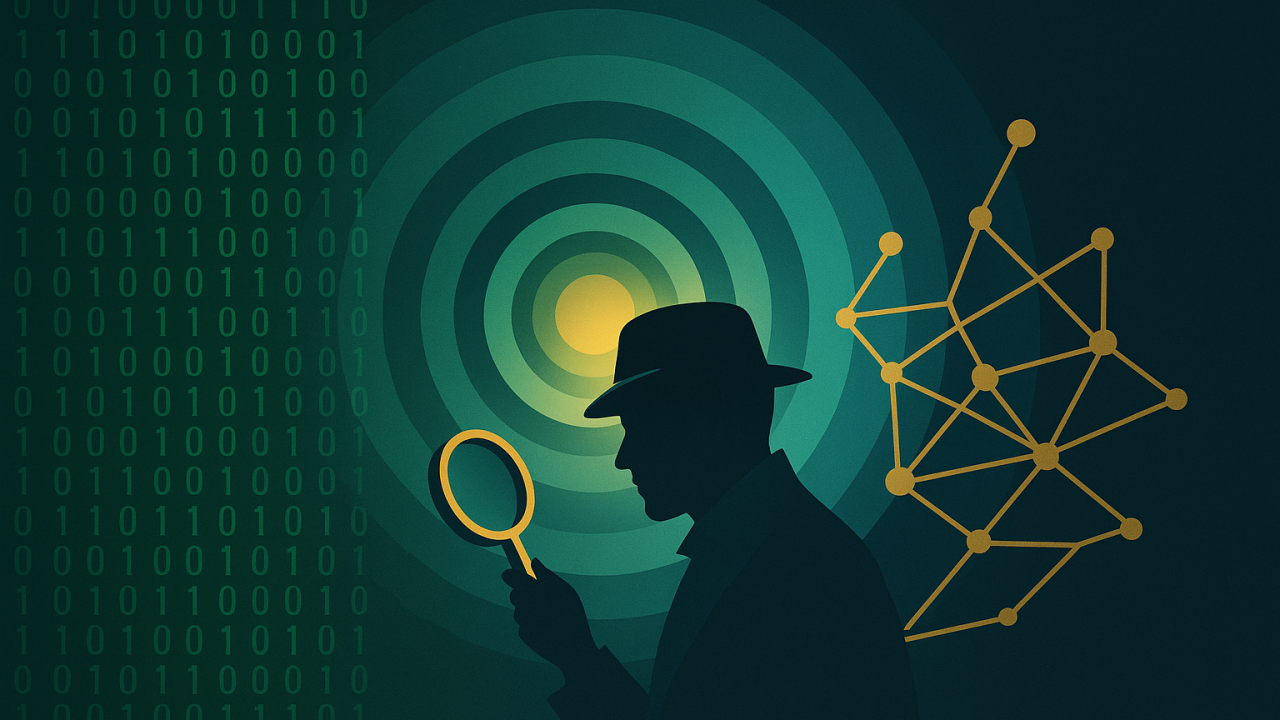
Yuval Noah Harari, in 21 Lessons for the 21st Century and more recently in Nexus, raises a fundamental question of our time: what happens when truth itself is lost, and untruths come disguised in convincing masks? In such a world, deception can appear elegant, attractive, and credible. To distinguish signal from noise, one must develop not only knowledge but also wisdom, intuition, and the courage to probe deeper. This provoked me to ask myself two questions: Can we think of investigation as a part or derivative of research? Can we think of AI as a part or derivative of investigation? The Pull of Investigation While watching web series like Special Ops and Poacher, I found myself reflecting on why I enjoy them so much. The answer came in a moment of clarity: it isn’t just the thrill of the chase—it is the art of investigation that captivates me. When we peel back the layers, investigation shares its DNA with both research and AI. AI as investigation → not about coding, but decoding. Teamwork → collaboration across disciplines, where each contribution matters. Networking → extending reach, leveraging people, knowledge, and technology beyond one’s own capacity. Suspense → curiosity to keep going, driven by the promise of discovery. Investigation and research are mirrors of each other. Both involve digging into the unknown, decoding what is hidden, and arriving at deeper truths. Both move us from superficial appearances to the core essence. Shades of Grey This naturally led me to reflect on the colour grey and why it resonates so much today. To move from black to white, we must pass through grey. It is the colour of transition, ambiguity, and complexity. We often hear about “fifty shades of grey” (not the film) as a metaphor for the layered, nuanced nature of life and truth. Grey is where we question, wrestle, and reframe. It represents the zone where truth and untruth wrestle with each other. As we move forward into 2026, the tone of grey seems to merge with the earthy richness of coffee. Coffee itself becomes a metaphor: Networking & Collaboration – coffeehouses have historically been “third places” where ideas are exchanged, loneliness dissolves, and collaborations are born. Warmth & Awakening – coffee sparks alertness, much like collaboration sparks creativity. Community & Belonging – coffee rituals remind us that progress rarely happens in isolation. Perhaps the future of work, collaboration, and even AI-driven ecosystems lies not only in technology but in these third spaces that reconnect us as humans. Dreams, Codes, and Truth At times, this journey feels cinematic. Like in Christopher Nolan’s Inception, we move through layers within layers—dreams within dreams. At other times, I feel like Neo in The Matrix, questioning reality itself. In one of the most memorable moments, Neo realizes: “Real is simply electrical signals interpreted by your brain.” That line captures the essence of our modern struggle. If reality can be coded, simulated, and manipulated—then what we call truth is fragile. It can be engineered, distorted, or even mass-produced. Which means our job, as researchers, investigators, leaders, and thinkers, is not only to decode what is presented but to ask whether the presentation itself is authentic. And sometimes, I see myself as Arjuna in the Mahabharata, standing in the battlefield of uncertainties, seeking clarity before action. The dilemmas, distractions, and deceptions of our age are no less daunting than Arjuna’s battlefield. This is where timeless wisdom guides us: “Asato Ma Sadgamaya, Tamaso Ma Jyotirgamaya” (Lead me from untruth to truth, from darkness to light.) A Framework for Investigating Truth in the AI Era To navigate this complexity, I see three steps that combine the disciplines of investigation, research, and AI: 1. Decode the Signals (Awareness) Just as Neo learned that reality could be electrical signals, our first responsibility is to question inputs. Ask: Where is this data from? Who coded this narrative? What assumptions shape this reality? 2. Dive Below the Surface (Depth) Grey zones demand we go deeper. Like investigators and researchers, we must peel layers—challenge first impressions, seek context, and identify hidden patterns. This is the movement from “coded” appearances to underlying truth. 3. Collaborate to Clarify (Collective Wisdom) No one decodes reality alone. Whether in a coffeehouse, a research lab, or a digital workspace, collective collaboration helps us balance biases, sharpen interpretations, and co-create clarity. Together, these steps form a cycle: awareness → depth → collaboration → renewed awareness. A living loop of truth-seeking. Closing Thought In today’s world, “truth” is no longer obvious. It is coded, packaged, sometimes deliberately disguised. The challenge before us is not merely to connect dots but to ask: are these the right dots? Investigation, research, and AI may appear different, but at their heart they share a common mission: to decode, to go deeper, and to reveal what lies beneath the surface. Just like Neo discovered in The Matrix, the world we see may only be a simulation. The real power lies not in accepting what is projected, but in questioning it—relentlessly. And in that sense, perhaps every one of us today is an investigator—seeking, probing, and decoding, in search of our own light. 👉 What’s your take? Is investigation the missing bridge between research and AI? 👉 How do you personally navigate the “grey zones” to arrive at your version of truth?


© 2024 All copyrights reserved by imagenshape