Excerpts of Reading on the Nobel Prize this year ( Part II ): Creative Destruction
15 Oct, 2025 Linkdin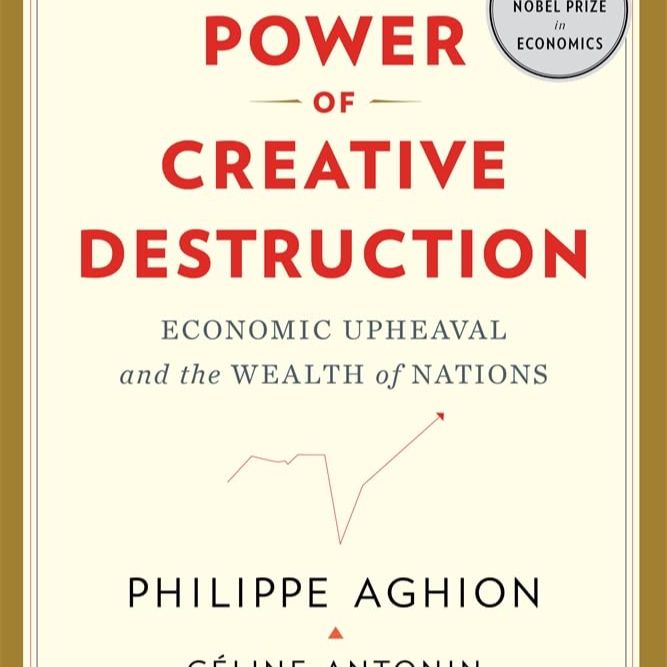
This year, the Nobel Prize in economics was awarded jointly to three people. One of the winners was economic historian Joel Mokyr, who shared the prize with economists (and teammates) Philippe Aghion and Peter Howitt. lets explore Philippe & Peter's work, mainly on creative destruction Creative destruction is a concept originated by an Austrian-born economist named Joseph Schumpeter. He said that capitalism is a constantly evolving process in which new technologies continually replace old ones. But such a technological shift comes with a lot of turbulence in the market. While new companies get created to implement new technologies, older firms go bankrupt as their stocks fall to zero. This also causes unemployment to rise as older jobs become obsolete. However, this turbulence is central to innovation — and hence economic growth. They go hand-in-hand. This process causes industrial revolutions every few decades, with new waves of technology emerging. The Industrial Revolution of the 1800s was merely the beginning. examples of creative destruction.- Be it lab-grown diamonds replacing natural ones, or how Intel lost out on the chip race, or the rise of solar in the world’s energy mix, or EVs slowly replacing gasoline vehicles, or, of course, the rise of AI. It’s everywhere for you to see. Aghion and Howitt wrote a paper on modelling creative destruction. In this model, firms actively invest in R&D to stay ahead of the competition. However, investing in R&D is highly risky. So, to incentivise such a process, a successful innovation is rewarded with a temporary advantage through extra profits. Why was this model so revolutionary? Here’s the thing: until then, in economics, innovation was treated as this thing that just happened on the side. It was considered necessary, but never part of the model itself. Through this model, Aghion and Howitt also explored an interesting relationship between innovation and competition. Innovation creates two contradictory, push-and-pull forces that influence the competitive structures of various industries. On one hand, when you make an innovative breakthrough, future innovators can piggyback on your work for far cheaper and build new innovations, even though you bear the initial risk. So you don’t fully capture that future social benefit—the next company does. How should the government regulate competition? Should regulators break up big tech companies like Google, NVIDIA and Microsoft? Well, it depends. If those companies are innovating rapidly and the competition for “the next big thing“ is intense, breaking them up might actually reduce innovation. But if dominant firms use their market power to block new entrants and innovation, then intervention could restore the healthy competition that drives innovation. The policy principle that emerges is: “protect workers, not jobs”. Will explore more in Part III....


© 2024 All copyrights reserved by imagenshape