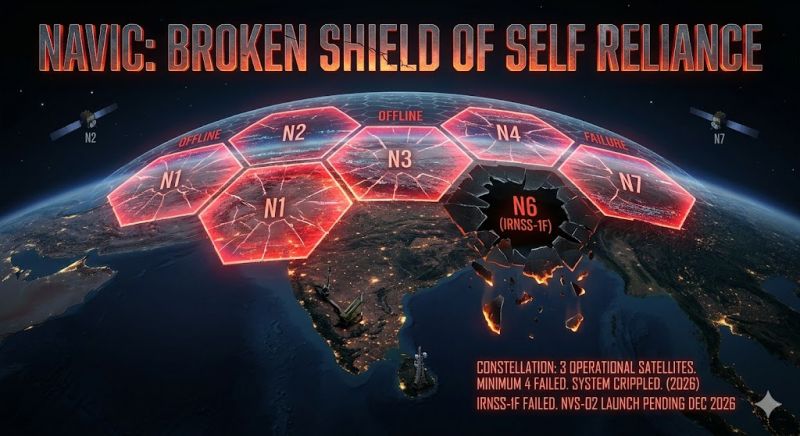
While we celebrate ambitious moon missions and human spaceflight, a silent crisis is unfolding 36,000 km above our heads. As of March 13, 2026, India’s indigenous navigation system, NavIC, has officially dropped below the "point of no return." The "Golden Number" is Broken To obtain a 3D position fix (Latitude, Longitude, and Altitude), a navigation system requires at least 4 functional satellites. With the total failure of the atomic clocks on IRNSS-1F two weeks ago, we are now down to just 3 operational satellites. The Reality: For the first time since its inception, NavIC is technically incapable of providing precise navigation across the subcontinent. We are "blind" on our own terms. A Comedy of Errors or a Strategic Lapse? The journey from the 1999 Kargil War (where the US famously denied us GPS data) was supposed to lead to total autonomy. Instead, we are facing a cascade of failures: The "Sindoor" Success: In mid-2025, NavIC proved its worth in Operation Sindoor, providing the pin-point accuracy needed for our standoff weapons. It was our shield. The Launch Drought: In January 2025, the NVS-02 replacement satellite failed to reach orbit due to a valve malfunction. The 2026 Deadlock: Another attempt in January 2026 was sidelined by "technical priorities" and launch vehicle anomalies. The Gap: We are now told replacements won't fly until December 2026. The 9-Month Vulnerability Window ⚠️ If a conflict breaks out tomorrow, India is forced back into the 1999 trap. We will be forced to rely on US GPS or Russian GLONASS. Can we trust foreign powers not to "throttle" our accuracy during a border skirmish? Can we afford to have our precision-guided munitions rely on a "borrowed" signal? The Wake-Up Call We have focused so much on "New Frontiers" that we have neglected the "Base Layer" of our national security. A navigation constellation isn't a "launch and forget" project—it's a living infrastructure that requires a constant "conveyor belt" of replacement satellites. The clock is ticking. And currently, for NavIC, it’s stopped.


© 2024 All copyrights reserved by imagenshape